Friday, November 1, 2013

A Visit to Sites in Farmville and Appomatox


by Jennifer Thomas
It is funny how little time we have as museum professionals to actually visit museums!  That’s why Christina and I were so grateful to be able to take a day out of the VAM office earlier this week and make our way to two member museums to see how they are doing.

Our first stop was the Robert Russa Moton Museum in Farmville.  The museum is housed in a 1938 African American high school, one that was distressingly overcrowded the day that the entire student body went on strike in 1951 and began their trek toward being among the plaintiffs in Brown v. Board of Education.  The school is an emotional space in its own right, but the new permanent exhibition (designed by VAM business member StudioAmmons, Inc.)  brings the amazing story of these students to life in such an evocative way.  I loved how the exhibition incorporated the original blackboards and classroom elements to help tell the story:

Our second stop of the day was the Museum of the Confederacy in Appomattox.  Opened just last year, the building in Appomattox was designed to better showcase some of the key artifacts from the Museum’s collection that relate to the final battles of the Civil War and Lee’s surrender.  The exhibit space, here, too, was very well done, with signature artifacts complemented by both low-tech interactive elements and high tech touch screens.  I was impressed at the care that was taken to make this history personal—all of the uniforms on display were tied to a specific person, whose photo and story were shown as well.  The museum isn’t about the battles of the war, but instead about the emotion and strategy that existed in the days immediately leading to the surrender, and what happened to the citizens and soldiers of the former Confederacy after the war.  The design and installation here were also done by VAM business members (Riggs Ward Design, and Explus, Inc.). 


This graphic illustrated the migrations of former soldiers and slaves that happened after the end of the war.

Though it never occurred to me that visits to these two disparate sites could complement each other, that is in the end exactly what happened.  Both exhibitions focused so much on the voices of the main figures involved that you could hear the same language repeated across generations.  The words of the white segregationists who fought Brown v. Board of Education eerily echoed those of the Confederate politicians and soldiers from the Civil War.  Both spoke passionately of states’ rights, and freedom, and the potential damage to their way of life.   Both also brought to mind some of the statements made by Tea Party politicians today.   If two short museum visits can enlighten someone who has been in the history field for over 15 years, imagine what they could do for the general public! 

Wednesday, October 23, 2013

Art & Commerce in the History City

Photo courtesy of Visit Savannah Facebook and @telfair on Twitter 
The annual Southeastern Museum Conference took place last week in the historically pertinent city of Savannah, Georgia and this year’s presentations, discussions, and events did not disappoint.  While I lean toward collection or exhibition-centric presentations, I heard from many other attendees that all were insightful and they have seen ways they could implement those ideas at their particular site or museum.  

For me, I particularly enjoyed hearing about how two art museums and a history museum used their quirky collection items and curated interesting and well attended exhibits for their community.  Two examples that really stuck out were an art museum used an overall theme of using 18th century William Hogarth prints as a “Where’s Waldo.”  To do this they picked several items from each print and found those in their collection for a case and the visitor needed to find them in the original work.  The other was a history museum, the curator was also teaching a museum college class, contacted many museums a certain distance away from them and asked for their weirdest or most different piece in their collection.  With all of those loaned items, they curated an exhibit that was interesting on fact of it made one consider how each organization decides what collecting policy was in place.  

I, myself, am going to try and use these and some of the other examples discussed in my own exhibit cases on a smaller scale.  When I consider ideas for exhibits at my institution, I like to display the neat objects but still throw a learning aspect into the display for my audience.  Whether it is through the normal short text panel or Fun Facts, the ideas mentioned in the presentation sparked interest in doing some new ways of exhibiting objects.  Everyone has those items stored at their institution that they do not really know what to do with, and these are just a few solutions.
           
The evening events were equally entertaining because this is the best time for all conference goers to gather at different museums around Savannah, see the building and artifacts, have a snack and hop on the trolley and move to the next site on the route.  I started at the Owens-Thomas House, an early 19th century home built in the finest English Regency style.  From there moving to the Telfair Academy to see the famed Bird Girl statue and finally ending up at the Jepson Center to see some of the Telfair’s contemporary holdings.

All in all, the SEMC annual event was well worth attending, and I hope to go again to see and meet others museum professionals from all over the southeast.  In the meantime, I will use the information and ideas I was presented with and put them into practice at my own workplace. 

Ainsley Powell
Assistant Librarian and Archivist
Saint Mary’s School, Raleigh, NC

Monday, September 9, 2013

Why Should You Support VAM's Circuit Riders During the Amazing Raise?


Have you heard? It’s time for the Amazing Raise! Your donations will all go to VAM’s Circuit Riders program. I can’t encourage you enough to help support this program that has proven so valuable to many of Virginia’s small museums.

The Circuit Riders program provides a half-day site visit from a curator and an archivist who look at the basic collections care and management needs of the museum. The site visit is followed by a brief report that includes suggestions for site-specific actions along with resources to help the museum practicably accomplish them. The atmosphere is informal, with questions and interchange throughout the visit.

Targeted for very small museums, especially those with small or all-volunteer staffs, the Circuit Riders is proving to be an effective way for them to get a lot of individualized help from a small investment (VAM funds the Circuit Rider visits, which are free to VAM museums). Sites get valuable feedback and suggestions for improving basic collections care and management at their own particular institution. Sometimes they need help with where to begin to get their collections on track, often they just need help deciding what steps to take in what order. They have the opportunity to discuss their own specific issues in a one-on-one collegial setting. As an outside consultation by experts in the museum field, Circuit Riders has also served as a means to engage board members and to help support grant applications.

It’s been really gratifying to hear what folks have been able to accomplish as a result of the CR visit. We’ve heard from museums that were inspired to start making changes as soon as we drove away, who asked for (and got!) funding for supplies we recommended, or who finally got management to give them what they needed to move forward.

To date VAM has helped over 30 small museums in VA through the Circuit Riders program. More folks like these need your help! Your support will help ensure it continues. Please visit VAM's donate page any time to donate to Circuit Riders. That page will redirect to the Amazing Raise donation interface on September 18th and 19th. Thanks for your support of the Circuit Riders!

Thursday, August 29, 2013

Morven Park; Leesburg, VA
VAM recently traveled to Leesburg, Virginia on August 22, 2013 for the presentation of our popular summer conservation workshop and historic Morven Park was the perfect location. 


Expert speakers, Alyson Rhodes-Murphy (Henrico County and Jana Shafogoj (Morven Park), presented the day-long session 'Care of Historic Structures' to a full house of 35 attendees. Below are a few photos from our beautiful day in horse country. 

Our mascot 'Virgil' makes some big friends!


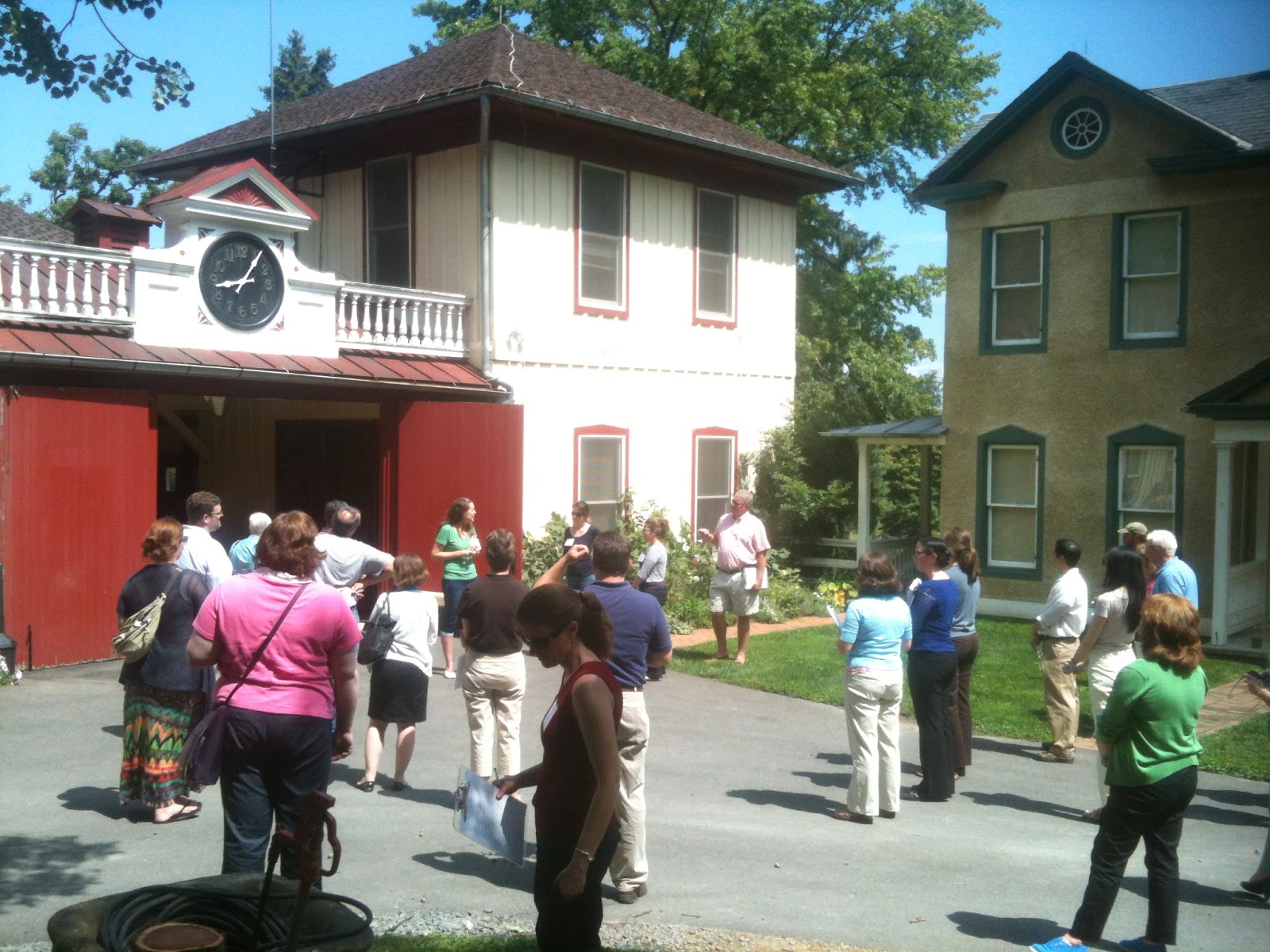
Workshop attendees were able to get hands-on training on how to assess historic structures on a tour of Morven Park's outside buildings. 


What a great day we had! Be sure to visit Morven Park and the many amazing historic and cultural sites in the Leesburg area. 

Are you looking to boost your skills? We've just released our Annual Workshop Series for 2013-2014 Season. Read more here!  

Sunday, August 25, 2013

Introducing VAM's New Assistant Director


It's an honor to be writing to you as VAM’s new Assistant Director. As a member of the Virginia Association of Museums, I've greatly appreciated and admired the fantastic conferences, informative programs, and excellent networking opportunities that I've experienced over the years, and I'm eager to have the opportunity to give back to the organization that has given so much to me throughout my career. My respect for VAM has only grown though after seeing first-hand the level of passion and dedication to the museum profession that exists amongst its staff, council, volunteers, and consultants.

It's been an honor to be part of this extended family over the past two years as project manager of the grant-funded Virginia Collections Initiative. I’m very proud to have had the opportunity to assist the incredibly diverse museum, library, and archive communities in Virginia and Washington, DC and of the work I’ve accomplished, from assisting members with renewals to expanding VAM’s recognition nationwide with the Top 10 Endangered Artifacts program. But I’m most grateful to now have the opportunity to take on a permanent leadership role at one of the most well respected museum associations in the country and continue to work alongside some of the best people I’ve ever met. Having worked with many of you already too, I look forward to building on our friendships and offer you my dedicated support in the years to come.

During the interview, I was asked what the greatest challenge would be, it was easy to reply, “filling Jennifer’s shoes”; but I feel confident in my abilities and 17 years of experience in the nonprofit cultural sector. As I’ve helped with the transformation of Downtown Richmond to an arts and cultural district, as founder of the popular First Fridays Art Walk, I look forward to sharing my passion with VAM to take it to its next stage too. The opportunities seem endless thanks to the many individuals, institutions, and businesses dedicated to our museum field.

Best,
Christina

Thursday, August 8, 2013

The Continuum of Excellence: Where Should Your Museum Begin?

VAM's upcoming member newsmagazine, the VAM Voice, will feature AAM's Continuum of Excellence. The new Continuum offers opportunities for various levels of assessment, feedback and recognition that build on one another. Programs along the Continuum include (but are not limited to) the following:

• Pledge of Excellence
• The Standards and Excellence Program (StEPs)
• Museum Assessment Program (MAP)
• Conservation Assessment Program (CAP)
• Core Documents Verification
• Accreditation (Association of Zoos and Aquariums (AZA) and Alliance)

It's easy, however, for museums - particularly those with small or all-volunteer staff, to know where to begin in this process. Thankfully, AAM has created a handy quiz, entitled The Continuum of Excellence: A Getting Started Guide, to help you navigate these opportunities and find the right one for your museum. Check out the quiz, and begin today on  your path to excellence!

Thursday, July 11, 2013

Jumping in with Both Feet: Reasons to Participate in Virginia's Top 10 Endangered Artifacts Program

As VAM is wrapping up its nomination period for the 2013 Virginia's Top 10 Endangered Artifacts Program, we thought we'd use this space for a little food for thought.

In it's third year, Virginia's Top 10 program has already come a long way. The program has been replicated already in several states, and two more states have plans to launch similar programs. Why? To put it simply, it's been a great success for the nominating museums and for VAM! Here are a few stats:


  • Back in 2011, we logged over 100,000 public votes for the inaugural "Top 10" !
  • Last year's program resulted in over 100 high-quality press clippings from media outlets such as The Washington Post and Virginia Living magazine, as well as radio (WTOP) and TV coverage!
  • Our second year resulted in over 120,000 public votes cast for conservation.
  • In this, our third year, we have already been picked up by the AP, and we haven't even announced our nominees yet!
  • To encourage donations to nominating museums, we have added a "donate" button to each nomination entry on this year's voting website. We hope that this results in museums attracting not only attention, but donations in support of conservation.
  • Many of our nominees from prior years have had great success leveraging their participation to get support for conservation efforts. From securing volunteers to funding, the Virginia's Top 10 Endangered Artifacts has been instrumental in many of our nominees and honorees conservation success stories!
Here's one final piece of good news - it's not too late to nominate! We'll be accepting nominations through this week and it only takes 10 minutes to nominate an artifact from your collecting institution! What are you waiting for?? Make a nomination now!