Saturday, March 29, 2014

Using Comparative History at Historic Polegreen Church in Mechanicsville, Virginia

by Elizabeth Baker, Director of Education and Outreach, and Kyle Meadows, Curator of Historic Resources, Historic Polegreen Church Foundation

The fight for religious freedom in Virginia began in Hanover in the early 1700s led by Samuel Morris and his group of dissenters against the Anglican Church. Between 1747 and 1759, Presbyterian minister Samuel Davies led the same group of dissenters in worship at Polegreen Church, the site of which now belongs to the Historic Polegreen Church Foundation. It is our goal at Polegreen to educate the public about the lengths Davies and the Hanover dissenters went to in order to gain freedom of religion--the freedom to practice any religion, or no religion at all.

One of the major comparative themes that we touch on in our interpretation of Historic Polegreen Church is the issue of church and state. In the 1770s, the Hanover dissenters fought for complete separation between the established Anglican Church and the state, in part claiming that a nation desirous of freedom had to include the freedom to believe according to one's own conscience. Their work was an important stepping-stone for Jefferson's Statute for Religious Freedom and the First Amendment.

Open up a modern newspaper, turn to a cable news channel, or go online, and people can find any number current events that relate to separation of church and state. Issues such as the Affordable Care Act and gay marriage often delve into religion, causing us to question what the Founders intended by the separation clause of the First Amendment, and how accommodating should the government be towards those with strongly held beliefs? We at Historic Polegreen find that it is not only useful, but also critical to our education goals to ask our visitors to think about the modern incarnation of religious freedom and how it compares to the struggles of Samuel Davies and the Hanover dissenters.

This summer, we are hosting a teacher institute in partnership with the First Freedom Center that will focus on the importance of religious freedom today, and how best to objectively teach religious freedom in the classroom. We'll ask teachers to engage in dialogue comparing the dissenters' fight to present-day struggles for freedom, and we'll discuss ways to tie religious freedom and the Polegreen story into SOLs for public schools. Comparing the experience of Davies and his followers to global and national struggles for freedom today makes history relevant to visitors of all ages.

Thursday, February 27, 2014

The Law of Unintended Consequences

by Adam Wallach, K-12 Coordinator for Social Studies, Stafford County Public Schools

 
The debate about eliminating SOL End Of Course Exams has risen to a fever pitch. There are a number of bills in the state legislature that call for cutting Social Studies and Science SOL exams. After having successfully fought off this issue in years past, it appears inevitable that there will be fewer tests possibly as early as next academic year. Less testing sounds wonderful! It is surely something that everyone can get behind- Democrat and Republican, Conservative and Liberal, student and teacher.

While, in theory, I am against high stakes testing because they rarely test what they claim to test, cause test anxiety in young students, and tend to favor a small number of students whose strength is demonstrating what they know on a traditional assessment. Despite my objections to high stakes, standardized tests, I disagree vehemently with removing SOL tests in Social Studies. Before you call me a hypocrite and burn me in effigy, let me lay out a case for why cutting SOL tests in Social Studies is more harmful than any potential benefits.

We have been subjecting students to high stakes SOL testing for almost 20 years. In that time, there is a well know axiom in public education. “If it isn’t tested, it isn’t taught.” Currently, the bills before the Virginia Senate seek to eliminate testing primarily in Social Studies, but also in Science. Specifically, HB 930 would remove SOL tests for 3rd Grade Social Studies, World History I (5th grade in Stafford) and World History II (6th grade in Stafford). Once these tests are gone, there is no accountability that the curriculum will be taught in any meaningful way. Even with the tests, the time allotted to teach Social Studies in elementary and middle schools has been disappearing. If the focus of the federal government and now state government is only on Mathematics and Reading, I fear that Social Studies instructional time will continue to dissipate. This trend of taking time from Social Studies in favor of Math and/or Reading is not just a Virginia issue, it is happening nationally.

The supporters of eliminating tests want fewer assessments especially in elementary school. HB930, which already passed the House and is in the Senate, calls for each school system to develop their own assessment to replace the SOL tests that are eliminated. If the purpose for removing tests is to unburden young students, clearly, this bill does not achieve that. It is counterintuitive to say you want fewer assessments, but you are actually keeping the same number. Additionally, the SOL test at the end of the course is not really the issue when you think about over-testing. All of the other testing that individual school systems require will still remain intact: Pre/Mid/Post tests, benchmark testing, universal screeners, diagnostic tests, teacher made tests and quizzes, mid-term exams, final exams, etc.

Some of my colleagues in the Social Studies community believe that they are leading a crusade to change testing in Virginia. Until the federal government treats all four core areas equally, it is naïve to think that advocating changes in Social Studies testing will impact how students are assessed by the state in Math or Reading. To truly change testing in the Commonwealth, the whole testing system needs to be overhauled. I believe and advocate fewer tests that are interdisciplinary. If we are serious about ensuring students possess 21st Century Skills and are career and college ready, we need to test skills not just content. Tests should have open ended scenarios that require students to analyze, synthesize, create, and use multiple skills from across the entire curriculum. This approach would allow for a real reduction in tests. For instance, instead of four SOL exams in 3rd grade create two tests. One would test use Reading as the basis, but incorporate Social Studies and Science content and skills. The other test would focus on Mathematics, but the questions would incorporate Science and Social Studies skills and content.

How does all of this impact Virginia museums and historical sites? You should be concerned about the “Law of Unintended Consequences” with any bill that eliminates Social Studies SOL tests. Once the tests are eliminated, the importance of that curriculum decreases. State accreditation will no longer be based on those classes. Therefore, the focus in schools will shift away from those courses. School administrators will focus entirely on Math and Reading. Resources will go toward Math and Reading. In a time when school budgets continue to shrink and there is less money available for field trips, why would a principal authorize a field trip to your museum if there is no impact on student achievement scores?

Before you decide to support elimination of tests in Social Studies, you should probably check your records from the last few years to see how many school age children visit your museum. If part of your funding stream involves field trips, you may want to have a contingency plan in place. If your museum is focused on school age children, you should be concerned. I suspect you will see far fewer class trips.

Book Review: Priceless: How I Went Undercover to Rescue the World’s Stolen Treasures

Review: Priceless: How I Went Undercover to Rescue the World’s Stolen Treasures, Robert K. Wittman with John Shiffman, Crown Publishing: 2010.


Priceless opens with an undercover art sting in Miami Beach, complete with a yacht, a Rolls Royce, and two French henchmen from the European art underworld.  This is the first glimpse we get of our protagonist, Robert Wittman, in this sting known better as Bob Clay, and the only thing odd about this Miami Vice-inspired scene is that it is a true story. Wittman, founder of the FBI’s Art Crime Team and senior investigator for the Bureau until his retirement in 2008, has some great stories to tell from his many years investigating art crimes.  He lays them all out for the reader like a holiday feast, and even includes some tantalizing hints about the most famous art heist of recent history, the Isabella Stewart Gardner theft in 1990. Wittman relays these stories in a bit of an unpracticed voice that is more beat cop than storyteller, but the reader can’t help but be intrigued and caught up in this view into a world we never see.... Read our full book review in the upcoming Spring 2014 VAM Voice member news magazine. 

Interested in hearing more about the FBI art crimes unit?  Don’t miss the Keynote Presentation at the 2014 Annual Conference, where our speaker will be Gregg Horner.  Horner is a current member of the FBI art crimes squad, and will share some of his experiences with our attendees on Tuesday, March 18th.  He will also be a part of a session later that morning on theft in museums.  

Wednesday, January 22, 2014

By Popular Demand: Your Selections, Your Gallery - A Crowdsourced Exhibition at the Chrysler Museum of Art

Special thanks to Cheryl S. White, Curatorial Coordinator, Chrysler Museum of Art, for authoring this blog post for us!

It has been just over a year since I’ve been able to sneak out of my office during the Friday-afternoon lull and wander around the galleries. This was one of the perks of working at the Chrysler Museum of Art, but since our building is closed for the first major renovation in nearly 30 years, I find myself getting nostalgic about the art. At first I didn’t notice it much. I saw works moving from galleries to storage, being prepped for loans to local venues, or having behind-the-scenes conservation treatments. It almost felt like nothing had changed—until the first day I donned a hard hat and found myself walking through half-demolished galleries with exposed ceilings and not a work of art in sight. My heart ached a bit. 

Tiffany Studios (American, 1902–1932)
Spider and Web Electric Lamp 
with Mushroom Lamp Base, ca. 1910
Leaded glass and bronze
Gift of Walter P. Chrysler, Jr. 
But then something beautiful happened…. I began to imagine the freshly painted walls glowing under state-of-the-art LED lights. I attempted to scale out the placement of paintings and pedestals based on our most recent floor plans. I walked into brand new galleries and the possibilities flooded my aching heart with excitement. All this new space was just waiting to be filled with all the art I had been missing for so long.

As the Curatorial Coordinator, I am lucky. I’ve had a front row seat to the process of selecting which works will be on display when we reopen on May 10, 2014. I scaled works of art to fit three-dimensional gallery models and cut and pasted tiny versions of Renoir and Veronese paintings until my hand cramped and glue sticks dried out. I tracked selections on spreadsheets and in databases as curators, conservators, and educators debated countless rounds of designs until the final plans emerged. And I’ll tell you a secret, they are nothing short of stunning. 

But, what about the works of art that just wouldn’t fit? The ones battled for, but ultimately cut? Those beloved works that the public seek out during repeated visits? Works that due to size or display limitations of the medium could not be included in this first round of installation? Aren’t these works of art equally worthy of display? 


These are just some of the questions that I, as a member of the Museum’s Community Conversations Committee, have been pondering. Comprised of 10 staff members, this group is dedicated to engaging the public in new and creative ways. In preparation of the Museum’s reopening we have vetted designs for new in-gallery response stations and have plans to launch a website where the public can upload their Chrysler memories. But, ultimately the Committee was responsible for determining the first exhibition in the Chrysler’s new Waitzer Community Gallery.  And while it would have been easy to curate a show ourselves, we saw this gallery as the perfect venue for a genuine community conversation.  Why not ask our community— who unknowingly have guided so many of our decisions this past year—to weigh in on some of those remaining, tougher-than-one-may-think art choices?

Thomas Hill (American, 1829–1908)
Early Morning, Yosemite Valley, 1884
Oil on canvas
Gift of Mr. Edward J. Brickhouse 
And again something beautiful happened: By Popular Demand: Your Selections, Your Gallery, a crowd-sourced exhibition drawn from nearly 40 works of art not slated for installation in our permanent galleries. Selections ranging from Tiffany Lamps to Warhol prints are up for election on the Museum’s website (www.chrysler.org/our-collection/bpd). Visitors can vote daily for up to 10 works and even provide us feedback on their choices. We envisioned this to be more than a popularity contest. It is an opportunity for our public to truly take the reins. We want to know how our community will curate. What interesting juxtapositions they will create? What will they find worthy of display?  Are seascapes preferred over cityscapes? Paintings over photographs? Will local artists triumph over Renaissance masterworks?  The top selections will be on view for our grand reopening on May 10, 2014. 

As an art-loving member of the community, I invite you to vote. I do regularly. And perhaps on a Friday afternoon in late May, I’ll bump into you in the Waitzer Community Gallery and you can tell me all about the works you voted to include!   


Choose your favorites for By Popular Demand at www.chrysler.org/our-collection/bpd. Online voting ends February 26, 2014.

Friday, November 1, 2013

A Visit to Sites in Farmville and Appomatox


by Jennifer Thomas
It is funny how little time we have as museum professionals to actually visit museums!  That’s why Christina and I were so grateful to be able to take a day out of the VAM office earlier this week and make our way to two member museums to see how they are doing.

Our first stop was the Robert Russa Moton Museum in Farmville.  The museum is housed in a 1938 African American high school, one that was distressingly overcrowded the day that the entire student body went on strike in 1951 and began their trek toward being among the plaintiffs in Brown v. Board of Education.  The school is an emotional space in its own right, but the new permanent exhibition (designed by VAM business member StudioAmmons, Inc.)  brings the amazing story of these students to life in such an evocative way.  I loved how the exhibition incorporated the original blackboards and classroom elements to help tell the story:

Our second stop of the day was the Museum of the Confederacy in Appomattox.  Opened just last year, the building in Appomattox was designed to better showcase some of the key artifacts from the Museum’s collection that relate to the final battles of the Civil War and Lee’s surrender.  The exhibit space, here, too, was very well done, with signature artifacts complemented by both low-tech interactive elements and high tech touch screens.  I was impressed at the care that was taken to make this history personal—all of the uniforms on display were tied to a specific person, whose photo and story were shown as well.  The museum isn’t about the battles of the war, but instead about the emotion and strategy that existed in the days immediately leading to the surrender, and what happened to the citizens and soldiers of the former Confederacy after the war.  The design and installation here were also done by VAM business members (Riggs Ward Design, and Explus, Inc.). 


This graphic illustrated the migrations of former soldiers and slaves that happened after the end of the war.

Though it never occurred to me that visits to these two disparate sites could complement each other, that is in the end exactly what happened.  Both exhibitions focused so much on the voices of the main figures involved that you could hear the same language repeated across generations.  The words of the white segregationists who fought Brown v. Board of Education eerily echoed those of the Confederate politicians and soldiers from the Civil War.  Both spoke passionately of states’ rights, and freedom, and the potential damage to their way of life.   Both also brought to mind some of the statements made by Tea Party politicians today.   If two short museum visits can enlighten someone who has been in the history field for over 15 years, imagine what they could do for the general public! 

Wednesday, October 23, 2013

Art & Commerce in the History City

Photo courtesy of Visit Savannah Facebook and @telfair on Twitter 
The annual Southeastern Museum Conference took place last week in the historically pertinent city of Savannah, Georgia and this year’s presentations, discussions, and events did not disappoint.  While I lean toward collection or exhibition-centric presentations, I heard from many other attendees that all were insightful and they have seen ways they could implement those ideas at their particular site or museum.  

For me, I particularly enjoyed hearing about how two art museums and a history museum used their quirky collection items and curated interesting and well attended exhibits for their community.  Two examples that really stuck out were an art museum used an overall theme of using 18th century William Hogarth prints as a “Where’s Waldo.”  To do this they picked several items from each print and found those in their collection for a case and the visitor needed to find them in the original work.  The other was a history museum, the curator was also teaching a museum college class, contacted many museums a certain distance away from them and asked for their weirdest or most different piece in their collection.  With all of those loaned items, they curated an exhibit that was interesting on fact of it made one consider how each organization decides what collecting policy was in place.  

I, myself, am going to try and use these and some of the other examples discussed in my own exhibit cases on a smaller scale.  When I consider ideas for exhibits at my institution, I like to display the neat objects but still throw a learning aspect into the display for my audience.  Whether it is through the normal short text panel or Fun Facts, the ideas mentioned in the presentation sparked interest in doing some new ways of exhibiting objects.  Everyone has those items stored at their institution that they do not really know what to do with, and these are just a few solutions.
           
The evening events were equally entertaining because this is the best time for all conference goers to gather at different museums around Savannah, see the building and artifacts, have a snack and hop on the trolley and move to the next site on the route.  I started at the Owens-Thomas House, an early 19th century home built in the finest English Regency style.  From there moving to the Telfair Academy to see the famed Bird Girl statue and finally ending up at the Jepson Center to see some of the Telfair’s contemporary holdings.

All in all, the SEMC annual event was well worth attending, and I hope to go again to see and meet others museum professionals from all over the southeast.  In the meantime, I will use the information and ideas I was presented with and put them into practice at my own workplace. 

Ainsley Powell
Assistant Librarian and Archivist
Saint Mary’s School, Raleigh, NC

Monday, September 9, 2013

Why Should You Support VAM's Circuit Riders During the Amazing Raise?


Have you heard? It’s time for the Amazing Raise! Your donations will all go to VAM’s Circuit Riders program. I can’t encourage you enough to help support this program that has proven so valuable to many of Virginia’s small museums.

The Circuit Riders program provides a half-day site visit from a curator and an archivist who look at the basic collections care and management needs of the museum. The site visit is followed by a brief report that includes suggestions for site-specific actions along with resources to help the museum practicably accomplish them. The atmosphere is informal, with questions and interchange throughout the visit.

Targeted for very small museums, especially those with small or all-volunteer staffs, the Circuit Riders is proving to be an effective way for them to get a lot of individualized help from a small investment (VAM funds the Circuit Rider visits, which are free to VAM museums). Sites get valuable feedback and suggestions for improving basic collections care and management at their own particular institution. Sometimes they need help with where to begin to get their collections on track, often they just need help deciding what steps to take in what order. They have the opportunity to discuss their own specific issues in a one-on-one collegial setting. As an outside consultation by experts in the museum field, Circuit Riders has also served as a means to engage board members and to help support grant applications.

It’s been really gratifying to hear what folks have been able to accomplish as a result of the CR visit. We’ve heard from museums that were inspired to start making changes as soon as we drove away, who asked for (and got!) funding for supplies we recommended, or who finally got management to give them what they needed to move forward.

To date VAM has helped over 30 small museums in VA through the Circuit Riders program. More folks like these need your help! Your support will help ensure it continues. Please visit VAM's donate page any time to donate to Circuit Riders. That page will redirect to the Amazing Raise donation interface on September 18th and 19th. Thanks for your support of the Circuit Riders!

Thursday, August 29, 2013

Morven Park; Leesburg, VA
VAM recently traveled to Leesburg, Virginia on August 22, 2013 for the presentation of our popular summer conservation workshop and historic Morven Park was the perfect location. 


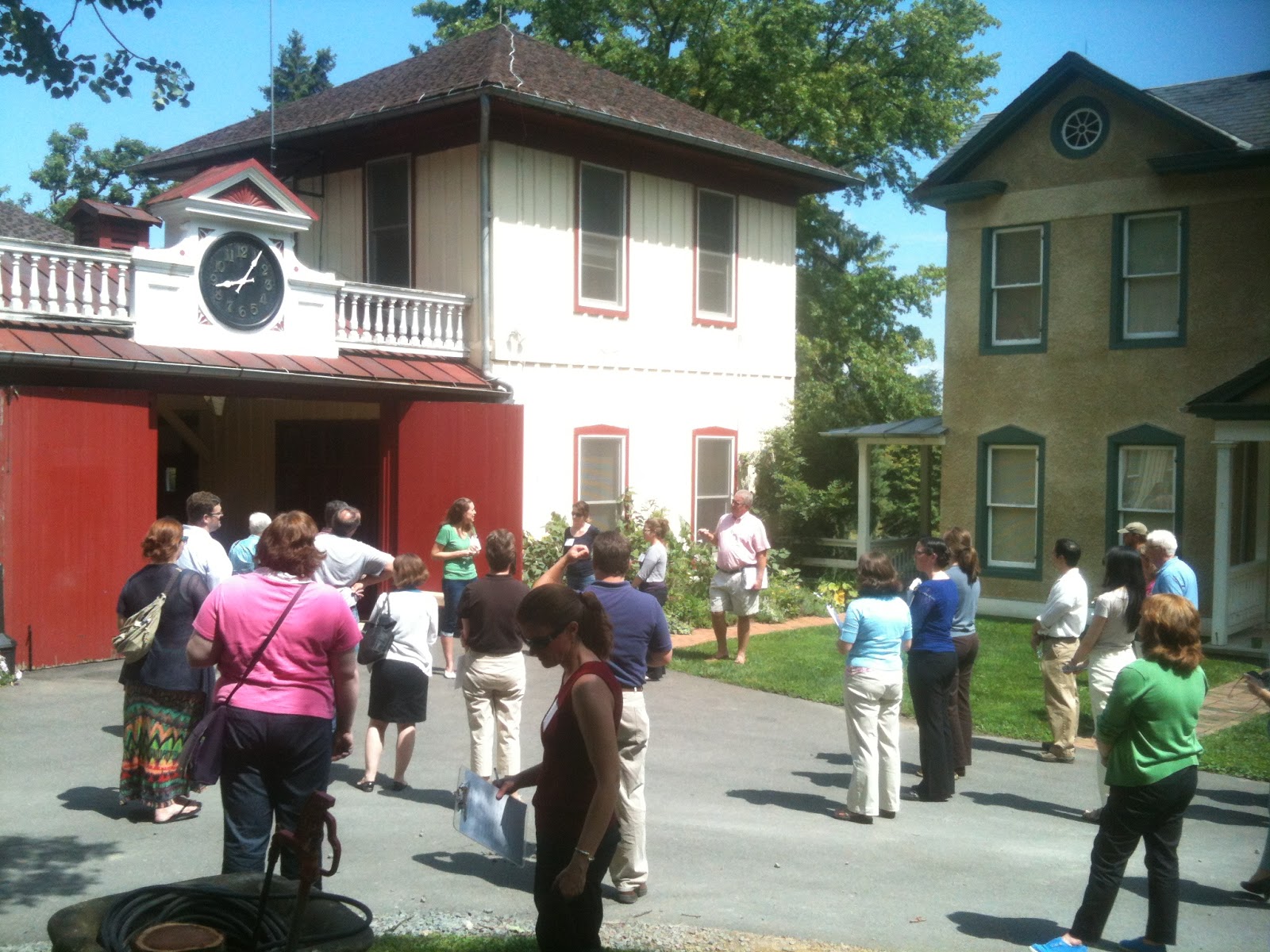
Expert speakers, Alyson Rhodes-Murphy (Henrico County and Jana Shafogoj (Morven Park), presented the day-long session 'Care of Historic Structures' to a full house of 35 attendees. Below are a few photos from our beautiful day in horse country. 

Our mascot 'Virgil' makes some big friends!


Workshop attendees were able to get hands-on training on how to assess historic structures on a tour of Morven Park's outside buildings. 


What a great day we had! Be sure to visit Morven Park and the many amazing historic and cultural sites in the Leesburg area. 

Are you looking to boost your skills? We've just released our Annual Workshop Series for 2013-2014 Season. Read more here!  

Sunday, August 25, 2013

Introducing VAM's New Assistant Director


It's an honor to be writing to you as VAM’s new Assistant Director. As a member of the Virginia Association of Museums, I've greatly appreciated and admired the fantastic conferences, informative programs, and excellent networking opportunities that I've experienced over the years, and I'm eager to have the opportunity to give back to the organization that has given so much to me throughout my career. My respect for VAM has only grown though after seeing first-hand the level of passion and dedication to the museum profession that exists amongst its staff, council, volunteers, and consultants.

It's been an honor to be part of this extended family over the past two years as project manager of the grant-funded Virginia Collections Initiative. I’m very proud to have had the opportunity to assist the incredibly diverse museum, library, and archive communities in Virginia and Washington, DC and of the work I’ve accomplished, from assisting members with renewals to expanding VAM’s recognition nationwide with the Top 10 Endangered Artifacts program. But I’m most grateful to now have the opportunity to take on a permanent leadership role at one of the most well respected museum associations in the country and continue to work alongside some of the best people I’ve ever met. Having worked with many of you already too, I look forward to building on our friendships and offer you my dedicated support in the years to come.

During the interview, I was asked what the greatest challenge would be, it was easy to reply, “filling Jennifer’s shoes”; but I feel confident in my abilities and 17 years of experience in the nonprofit cultural sector. As I’ve helped with the transformation of Downtown Richmond to an arts and cultural district, as founder of the popular First Fridays Art Walk, I look forward to sharing my passion with VAM to take it to its next stage too. The opportunities seem endless thanks to the many individuals, institutions, and businesses dedicated to our museum field.

Best,
Christina

Thursday, August 8, 2013

The Continuum of Excellence: Where Should Your Museum Begin?

VAM's upcoming member newsmagazine, the VAM Voice, will feature AAM's Continuum of Excellence. The new Continuum offers opportunities for various levels of assessment, feedback and recognition that build on one another. Programs along the Continuum include (but are not limited to) the following:

• Pledge of Excellence
• The Standards and Excellence Program (StEPs)
• Museum Assessment Program (MAP)
• Conservation Assessment Program (CAP)
• Core Documents Verification
• Accreditation (Association of Zoos and Aquariums (AZA) and Alliance)

It's easy, however, for museums - particularly those with small or all-volunteer staff, to know where to begin in this process. Thankfully, AAM has created a handy quiz, entitled The Continuum of Excellence: A Getting Started Guide, to help you navigate these opportunities and find the right one for your museum. Check out the quiz, and begin today on  your path to excellence!

Thursday, July 11, 2013

Jumping in with Both Feet: Reasons to Participate in Virginia's Top 10 Endangered Artifacts Program

As VAM is wrapping up its nomination period for the 2013 Virginia's Top 10 Endangered Artifacts Program, we thought we'd use this space for a little food for thought.

In it's third year, Virginia's Top 10 program has already come a long way. The program has been replicated already in several states, and two more states have plans to launch similar programs. Why? To put it simply, it's been a great success for the nominating museums and for VAM! Here are a few stats:


  • Back in 2011, we logged over 100,000 public votes for the inaugural "Top 10" !
  • Last year's program resulted in over 100 high-quality press clippings from media outlets such as The Washington Post and Virginia Living magazine, as well as radio (WTOP) and TV coverage!
  • Our second year resulted in over 120,000 public votes cast for conservation.
  • In this, our third year, we have already been picked up by the AP, and we haven't even announced our nominees yet!
  • To encourage donations to nominating museums, we have added a "donate" button to each nomination entry on this year's voting website. We hope that this results in museums attracting not only attention, but donations in support of conservation.
  • Many of our nominees from prior years have had great success leveraging their participation to get support for conservation efforts. From securing volunteers to funding, the Virginia's Top 10 Endangered Artifacts has been instrumental in many of our nominees and honorees conservation success stories!
Here's one final piece of good news - it's not too late to nominate! We'll be accepting nominations through this week and it only takes 10 minutes to nominate an artifact from your collecting institution! What are you waiting for?? Make a nomination now!

Tuesday, June 11, 2013

Historic House Museums: Branching Out

by Jody Allen

Historic houses offer visitors an authentic look into the past. Decorated and furnished with historical accuracy, historic houses tend to offer an immersion experience for their visitors. Unfortunately, attendance for historic houses has dwindled over the years and many establishments are looking for unique ways to boost visitation. Here are some innovative tactics that can help remedy low audience numbers.

Local Art
Many historic houses have available, unused rooms. Instead of leaving these rooms vacant, why not offer a place to showcase local artwork? Local art can help bring a different audience into your historic house – an audience that may not otherwise come, or who may not even be aware of your historic site! If the idea of including artwork unrelated to your site doesn’t interest you, consider asking local artists to create pieces inspired by your historic house. Not only would these pieces bring in a new audience, but they would also relate to your establishment. Another art related idea to consider is renting out available rooms to individual artists as studio space. 

Events
Historic houses make great locations to host small outdoor events. If you’re looking to bring in an audience, consider hosting a concert. Something simple that showcases local talent can attract a decent-sized crowd to your location. If money is an issue, charging a small entry-fee could help. Additionally, a “concert on the lawn” where attendees bring their own chairs and blankets alleviates the stress of providing seating. For example, Richmond’s Wilton House Museum is hosting a Jammin’ on the James Concert Series this summer.
In addition to concerts, feel free to explore other outdoor event possibilities. Consider hosting a farmers market, family day, or historic re-enactments.  Anything that can attract new audiences can prove beneficial to your historic house and keep it a relevant component of your community.

Community Partnerships
Interacting with your community is a great way to attract visitors and can lead to steady visitation. Historic houses tend to have plenty of outdoor space that can be used for community-based activities. Offering a community garden is just one way to incorporate members of the community. A community garden can help educate people on proper agriculture practices, as well as help build a stronger community. The strict definition of a community garden is one that is gardened collectively by a group of people. Partnering with a local garden club or a nearby community association can forge new ties in your community that will bear both figurative and literal “fruit.”


If your historic house has neighboring historic houses, you may want to also consider joint-hosting a community walk or other fitness event. These events promote healthy lifestyle choices while educating participants on the history of the area. For example, in Richmond, there is a 10K walk entitled "Go! Discover Richmond" that is run through the city's SportsBackers organization, but partners with sites throughout town. Another, simpler option is making sure you are on your town’s listing sites of interest. For example, visitors to Tappahanock may visit you if you are part of their town walking tour. 

Teachers: Stewards of Future Audiences
If you want to engage younger generations, even if you cannot accommodate large school groups, reach out to teachers in your community. Offer an open house for educators, distribute free passes to staff of your local elementary school, and consider hosting teacher workshops. VAM has a listing of some teacher workshops throughout the state, and many historic houses and small museums cultivate their school relationships directly through building relationships with the teachers. Additionally, reach out to scouting and other youth organizations and see what other community partnerships could develop as you think 'outside' the box and look at both your site's offerings and your community's needs.

Stay Tuned to VAM
We will be hosting a Summer Conservation Series Workshop on the Care of Historic Structures in August. Additionally, we'll be hosting a pre-conference activity on historic houses on Saturday, March 15, 2014 in Alexandria. We'll be announcing more information on that as the time gets closer. Stay tuned! Additionally, Preservation Virginia is planning an event for historic house staff on October 22nd, as a part of their annual conference. More details will be released about that soon as well!

Thursday, May 9, 2013

Salem Museum's "You-Seum" Exhibit, by John Long


Local history museums like us are always up against demographics. I often say you don’t appreciate local history until you’re old enough to remember some of it. As a result it’s sometimes hard to engage the younger generation and involve them in our mission.  This in part led us to our first foray into the “pop-up museum” phenomenon a few weeks back.

We called it the “You-Seum--a one-night exhibition designed by you!” We shaped it around the theme “Great-Grandma could have never imagined…” and invited the public to bring in an item to illustrate that theme. We set few ground rules, allowing the participants to drive the discussion in their own way. The turn-out, while smaller than we would have liked (there were several other events in town that lovely April night) but enthusiastic. The ages ranged from 6 to over 90. The six-year-old came to show off her Disney Princess collection.

The entries were insightful and thought-provoking. One of our members brought his tablet and e-reader; technology obviously outside of Great-Grandma’s imagination. Another brought a photo of herself having coffee with an African American friend--an encounter her great grandmother probably would have never sanctioned. The assistant director opined about the frenetic pace of modern life, which would have baffled our more relaxed ancestors. She illustrated it with a dvd showing of the Andy Griffith episode “Man in a Hurry.” One of our older members brought a slightly risqué sculpture--her great-grandmother could have never imagined such a thing in a respectable museum.

One participant grew up on a small Chesapeake Bay island, which was fundamentally transformed a generation ago when a bridge was built to the mainland. She brought in a nostalgic display of hometown items showing what was gained--and what was lost-- when the modern world intruded onto her island.
My own great-grandparents’ farm is now the site of a strip mall, mostly vacant, where the most popular shop is Dunkin’ Doughnuts. So I brought a dozen assorted pastries--Great-Grandma Long probably never tasted one, much less could foresee them sold from her cornfield. For the first time in my career I put out the sign “Please eat the exhibit.” Around the room, conversations mulled the changes we’ve all seen in such a short period of time. One of our goals was to get people thinking, and we did it.

On the whole, it was a most enjoyable evening and we plan to offer it again with a different theme. Along the way, if we can achieve a reputation as a museum that has more than static exhibitions to observe passively from behind velvet ropes; as an innovative facility where visitors can learn from enjoyable, engaging programs, then we’ll have crossed the bridge from yesterday’s museum to a brighter tomorrow.

Tuesday, April 9, 2013

Handling Public Relations Effectively: For Organizational Leaders, Boards, and Stakeholders


Today I had the privilege of attending a seminar entitled, “Avoiding the Public Relations Cliff: Lessons Learned from the UVA Board and President Crisis,” hosted by the Virginia Society of Association Executives. The speakers were Susan S. Gaston, president and owner, The Gaston Group and Joel Rubin, APR, founder and president, Rubin Communications Group. Both of these seasoned professionals in the area of public relations (PR) gave us a synopsis of “18 very bad days” in June of 2012 when UVA experienced an unexpected ‘coup’ of University President Teresa Sullivan.

The episode at UVA was presented as a case study and a springboard for discussion on managing crises, understanding the various audiences that follow your organization’s actions, working with and managing the media, and knowing who will be a spokesperson and when and how your organization should conduct interviews or make statements in times of crisis.

To provide just a few of the takeaways from this seminar, the speakers outlined the following steps to take if you find your organization in a PR crisis:

• Be candid and acknowledge the crisis / problem
• Offer an explanation (do not skirt this by “issuing statements,” you may need to answer some hard questions)
• Contrition / verbalization – be honest, and if necessary, contrite about what has happened
• Consultation – consider whether your organization would benefit from either legal or PR expert advice.
• Commitment – demonstrate and verbalize your organization’s commitment to solving the problem or mitigating the crisis.
• Restitution – this goes hand-in-hand with commitment. If an action needs un-doing, or steps need to be taken to remedy the situation, have a plan and execute it.

Another excellent facet of this seminar dealt with board responsibilities, board training, and the characteristics of excellent board leadership. Stay tuned – we’ll follow up with another post on that soon!

Thursday, February 28, 2013

Session Preview: Engaging Your Audience with Social Media


Social media continues to grow in its importance to our organizations. Everyone is on Facebook, and many are on Twitter, Pinterest, and LinkedIn. And those are but a few of the many platforms available.  How do you prioritize which outlets to use, who manages social media at your museum, how often should you post, and how does this interact with traditional media? So many questions.

VAM has some answers, from a seasoned museum/tourism communications team at the session “Engaging Your Audience with Social Media.” And as you might expect from communications and marketing professionals, the team is seeking your input to design a session that meets your needs. Visit their Facebook page, “VAM Engaging Your Audience with Social Media” and after you register, please respond to the survey about this session to further assess your needs.

Social media is a dynamic field, full of constant changes and surprises. With some preparation and the right resources, you can capably represent your museum in this exciting dimension of communications. See you at the Homestead!

Suzanne Hall  
Chief Communications Officer
Virginia Museum of Fine Arts
200 N. Boulevard / Richmond, VA 23220-4007
T 804.204.2704 / F 804.204.2707 / M 804.839.3488
email: suzanne.hall@vmfa.museum

Tuesday, February 19, 2013

Viewpoints on the VAM Conference: Michael Remorenko of MuseumRails


I have had the pleasure of working with Margo and her staff as a Resource Hall exhibitor at the VAM conferences for over 15 years, both as Design 3 and, more recently as MuseumRails. The experience has always been first rate, whether times were good for the museum profession, or we were suffering through some of our slower years. The Resource Hall has always been an excellent opportunity for us to connect with our professional friends, and current and potential clients. We have been awarded several contracts, and enjoyed a number of sales that can be directly tied back to introductions and conversations that first took place in the Resource Hall during the VAM conference.

Further, among my professional acquaintances, VAM is consistently cited as THE best of the regional museum conferences. The programs and speakers are consistently excellent. Further, the staff goes out of its way to accommodate the exhibitors and, importantly, to create opportunities and encourage conference attendees to visit the Resource Hall vendors and see what we have to offer. For anyone trying to reach Virginia (and increasingly, regional) museum professionals, I don't know of a better, more accommodating opportunity than the VAM Conference Resource Hall.


Best,
Michael

Michael Remorenko

MuseumRails
Michael@MuseumRails.com
www.MuseumRails.com


Thursday, February 7, 2013

Viewpoints on the VAM Conference: Glavé & Holmes' Steven Blashfield


Somewhere after January 1st every year I start to really think about the upcoming VAM Conference as I start to look ahead. It is really a nice kick off, coming in the early part of the year. In the past few years, I have been a speaker, a vendor and a sponsor, continuing the support of VAM by my firm, Glave & Holmes Architecture, now for more than two decades. So, the leading up to the annual conference is also a good bit of work. But, its good work, and work that culminates in a fun and engaging three day event, which I truly look forward to each March. Over the last three years, my work has taken me to numerous conferences, including AAM, SEMC, AASLH, and state museum association conferences in Tennessee and South Carolina. I can easily say that from what I have experienced Margo, Jennifer and their team run one of the best conference experiences in which I have participated. Last year, I laughed heartily as the guest speaker at the Leadership Program joked about taking clandestine photos with his colleagues of each wearing General Patton’s helmet, in the back room. In Portsmouth, I was inspired by the global warming exhibit in the Courthouse Gallery, but then I think I almost threw out my shoulder in the pitching machine at the Virginia Sports Hall of Fame. I have learned some very interesting stories, been amazed by the masterful effort put in by our Virginia museum professionals, and made some good friends. 
The Hermitage Museum and Gardens

I always come out of the three day event with a few museums I just have to visit. This past year’s conference led me into the Federal Reserve Museum in Richmond, Gatsby’s Tavern and the Apothecary Museum in Alexandria, the James Monroe Museum in Fredericksburg, and to ultimately become a Trustee at the Hermitage Museum & Gardens in Norfolk. It’s kind of like a tractor beam how they pull you in.


Interestingly enough, my connection to the Hermitage Museum started several years ago, at my first VAM conference, held in Richmond. The Museum Director, Melanie Mathewes, stopped by my booth in the Exhibit Hall, and noting my last name proceeded to tell me how they had a collection of work by one of my distant relatives, an accomplished muralist named Edwin Howland Blashfield. She proceeded to pull her head curator over, who exclaimed, “It’s like meeting a celebrity.” Nothing like stroking the ego a little. But, also at the same time funny how curator’s get wrapped up in their work. For a painter who kicked off his career by painting a ceiling in one of the buildings of the famous 1893 Chicago World’s Fair, a seminal point in history for architect’s like me, has paintings in museums coast to coast, and completed murals in numerous State Capitols and the Library of Congress, Blashfield is remarkably unknown. So, to find someone who already knew this distant history of my own ancestors and was excited about it … well what can I say. But, it’s also why I have gravitated to museums in my profession; they are all such wonderful opportunities for discovery. I can’t wait to see what new things I will discover this year.

(Photos are Edwin Howland Blashfield and his Evangeline, and the Hermitage Museum & Gardens – Norfolk – both are courtesy of the Hermitage Museum & Gardens)

Steven Blashfield, AIA, LEED AP
Cultural Studio Director 

elevating the human spirit …

2101 E. Main Street
Richmond, VA 23223
t: (804) 649-9303
f: (804) 343-3378

Friday, February 1, 2013

VAM Circuit Riders Visit the Old Coast Guard Station Museum in Virginia Beach


“For foot candles, it’s a little high for paper, but not that bad.” – Jeanne Niccolls
If you know what the quote above means, then maybe your job has something to do with care and conservation of your museum’s collections. VAM staff members were privileged to accompany our Circuit Rider team of a curator (Jeanne Niccolls) and an archivist (Bradley Wiles) to the Old Coast Guard Station Museum (OCGSM) in Virginia Beach for their one-day mini needs assessment of the collections and storage areas. It was fascinating to see the process, and to hear about the challenges faced by those who are charged with the stewardship of museum collections.
While every collecting institution has its challenges, those at the OCGSM are unique indeed. I had this thought as I looked out from the collections storage area, enjoying the million-dollar view of the Atlantic Ocean, with its wisps of salty foam being blown around by humid ocean breezes. Humidity, variations in heat/cold, sunlight, salt, and sand- not to mention threats posed by tropical storms and hurricanes - are all part of the environment where the collections of the Old Coast Guard Station Museum are held. Theirs is quite a challenge indeed. As we walked through the museum and the collections area, I overheard museum staff (Director Kathryn Fisher, Registrar Leslie Small, and Educator Darcy Nelson were in attendance for the visit) and Circuit Riders discussing the following issues, to name just a few:
  • Lighting and pest control
  • Budget issues when different entities own the building vs. the collections that the building houses
  • Accessibility of collections for monitoring purposes
  • Collections insurance
The visit made me wonder – “Where do you begin?” with collections management. Apparently my question was not unique. Said Kathryn Fisher, director of the OCGSM, “I didn’t know where to start…. All I could see were the brambles, regardless of there being a forest beyond.” Well, one of the things that Kathryn started with was welcoming a visit from VAM’s Circuit Riders. After the visit, the VAM Circuit Riders provide participating museums with a detailed report that outlines recommendations for collections priorities and indicates simple - usually inexpensive - actions that can be taken immediately or in the next couple of years, and occasionally long term plans/suggestions that may require budget planning.

Find out more about Circuit Riders as well as the Old Coast Guard Station Museum in the upcoming Spring edition of the VAM Voice member newsmagazine. Interested in applying for a Circuit Rider visit? Find out more online at www.vamuseums.org. 

Monday, October 22, 2012

Meet Virgil the VAM Gnome!

Virgil Visits the Science Museum of Virginia
Virgil is a history buff, and art aficionado, and a part-time lawn ornament (especially when visiting botanical gardens)! When he isn’t lounging around, Virgil is traveling the globe – or at least Virginia. Virgil’s passion for traveling is unmatched. There isn’t a place he won’t go to. In addition, Virgil’s bravado is awe-inspiring and he’s never met a stranger who didn’t become his friend.

Due largely in-part to Virgil’s inspirational personality, he has been appointed VAM’s newest travel buddy. This means he’ll be joining the rest of the VAM staff at various functions throughout the state, so be sure to keep your eyes peeled for him whenever you’re at a VAM related workshop, meeting, or conference.

Virgil Visits Chihuly at the VMFA
So if you see Virgil at an event, be sure to say “Hi!” and maybe even snap a picture with him. Just remember: no short jokes (Virgil hates those!).

Want the gnome to visit your neck of the woods? Contact VAM if you are interested in hosting a workshop, a member networking event, or an emergency preparedness meeting.

Thursday, September 20, 2012

Grateful for Amazing Friends

As we hurl headlong into the final hour of The Amazing Raise, Richmond's 36-hour giving challenge, we at VAM are so grateful for all the support we've seen in the past day and a half. Our Circuit Riders program supports conservation efforts throughout Virginia and DC, many times at the smallest and most vulnerable collecting institutions. As the Heritage Health Index Report points out, 50% of US collecting institutions do not have a written, long-range plan for the care of the collection; and nearly 80% of archaeological collections are in unknown condition or in need. We know that you understand the importance of collections care and conservation, and we thank you for trusting us to be good stewards of your donations.

For those of you who may still be considering whether, or how much, to give, please consider the following:
  • Circuit Rider sites do not have to pay for the Circuit Rider visit. We'd like to keep it that way.
  • We are currently funding 10 Circuit Rider visits per year through an IMLS Connecting to Collections Statewide Implementation grant. When the grant period is over, the visits will end without your support.
  • Each Circuit Rider visit costs $500, which covers the cost of sending an archivist and a curator to a site visit at a collecting institution, and provides the institution with their written report to help the organization's leadership set priorities for collections care.
  • The Circuit Rider program addresses many of the same stewardship areas as the American Association for State and Local History’s StEPs program and is based on the American Association of Museum’s Collections Stewardship Assessment Program (CSMAP) and Heritage Preservation’s Conservation Assessment Program (CAP); consequently, participating in Circuit Riders can help collecting institutions prepare to pursue the StEPS program or determine your readiness for a more comprehensive CSMAP or CAP. 
  • Circuit Riders helps small collecting institutions develop preliminary strategies for improving collections care by identifying and prioritizing actions to implement improvements.
Plus, your gift is tax deductible and supports conservation throughout Virginia and Washington, DC.
If you make a tax-deductible gift of $50 or more, VAM will send a coupon code (via email) good for $25 off of conference 2013 registration. Conference 2013 will be held at The Homestead from March 9 - 12th. The Homestead is generously offering conference-goers the super-low room rate of $95 a night.

So as we head into the final "Procrastinator's Hour" of The Amazing Raise, we thank those of you who have already shown your support, and we ask the rest of our fantastic friends to consider giving if you can. Give online by 6pm at VAM's Amazing Raise Donation Site.