Whenever museum staff get together, one of the first topics of conversation that comes up is visitor counts. Even if we’re a free attraction, like the National Museum of the Marine Corps, we live by the numbers, or so it would seem. Grant applications ask the question of us; so do donors and marketers and our boards and bosses. For that question, there is an easy answer. We count electronically at Quantico; many use the clicker method or count sales if they have paid admissions. After last year’s rough economic times, the Marine Corps Museum’s numbers have picked up. Since we opened in late 2006, we had the best ever months in 2010 for May through August, and we welcomed visitor # 2 million this summer. But the “who” question is much harder to answer!
Visitor research and analysis is a specialized art in which I, for one, have had no formal training, and that is now high on my professional improvements to-do list. But we didn’t let that stop us from trying to find out who was visiting the National Museum of the Marine Corps, where they were coming from, why, and anything else we could glean from survey data. And we’ve probably made mistakes at everything we’ve tried. The good news is that even with the learning curve, the data we’ve collected since summer 2007 have all meshed and have been validated from one survey to the next. Here’s what we’ve done and what we learned—and what we could have done better.
Part 1. Using summer college interns during our first season, we did a quick exit survey and then some visitor stalking because we wanted to know what was going on in our galleries. The exit survey work was pretty straight forward: where from, age, military background or not, first visit or not, length of stay, level of overall satisfaction. And we observed the sex of the respondents. Our interns interviewed every 10th person as they left the Museum, over a combination of mornings, afternoons, weekdays, and weekends. And then with clipboards in hand and with signage in place advising visitors that we would be observing them in the WWII gallery, we tracked how long our guests lingered in various locations, whether they seemed to be reading labels or not, if they looked up at the aircraft and other visuals overhead, how long they watched videos, and how much conversation was taking place among visitors who were mingling with others. That was all a lot harder than is sounded!
In part two of this series, we’ll look at the exit survey data as it compares to a more formal collection of visitor information. The visitor observation work we did in 2007 is the only exercise of this kind we’ve tried. We followed visitors over a combination of mornings and afternoons, weekdays and weekends. Over 40% of our visitors spend 3+ hours in the Museum; that year we had three historical galleries in place, including WWII. Of the visitors we tracked, they spent about 25 minutes in this gallery, our largest. Videos, some of which run as long as 8 minutes, kept visitors engaged for 90 seconds. Very few folks picked up the headsets to listen to oral histories; fewer seemed to look up and notice the artifacts and signage above them. Our guests did seem to read labels and share their reactions with others around them. They “socialized” the experience. Apparent families and assumed veteran groups discussed the exhibitions with the most animation.
Because we were in the midst of tweaking the design of three new galleries at the time, we used this information right away. We shortened new videos; angled aircraft hanging in the ceiling as much as possible, dramatically lit them, and included engine audio; “dressed up” oral history stations and shortened run times; and made the new galleries more navigable for groups where we could. We left text length alone.
We need to do more visitor-tracking, but our “stalkers” need more training to develop their powers of observation. The form on which we record our observations needs to be more streamlined and more inclusive (we made observations at a limited number of “stations”). We need to engage the subjects as they exit the area to capture actual data about them, rather than make assumptions. And we need to plan on observing for longer periods of time; it is a labor intensive exercise. We seriously underestimated the time factor. Young college students clearly stood out; we should consider using a combination of older and younger observers. We did not see any significant variations in the observations based on time and day.
Who has experience and advice on visitor tracking? What training aids have you used that were especially helpful? What did you do as a result of the data collected? Next time, we’ll look at visitor demographics.
—Lin Ezell, Director, NMMC, and VAM Council Member

Wednesday, September 8, 2010


Thursday, August 19, 2010
Save the Date!
'Ask a Curator Day' on September 1st 2010 will open the door to field experts with a unique worldwide question and answer session which will let interested members of the public put questions to museum and gallery curators. Check it out at http://www.askacurator.com/about.html.
- Heather
- Heather
Friday, August 6, 2010
Curating up a storm…
I curated up a storm this week. There was a film series, several music playlists, and an exhibition.
Wait. I think I heard a chorus of voices – crying out in the museological wilderness. Are they trying to tell me I didn't curate anything but an exhibition?
See – This is my problem with the curatorial profession right now. There is a certain jealousness about the title that needs to be overcome. And there is a redefinition that must be acknowledged if museums are to (in the grand old words of Freeman Tilden) be relevant to their visitors.
We need to allow those who may not be traditionally be thought of as 'curators' to co-opt the title. And we need to look at what they are doing. Because I think we might just learn something.
I remember when I first assumed the mantle of 'curator' a few years back. A dear friend of mine called to congratulate me. She was effusive about my new job and very happy for me. But she paused during the call – and asked, quite sincerely – 'so, what exactly *is* a curator, anyway?'
Funny thing was – I really couldn't answer.
Oh – I could tell her what the dictionaries said, and what other curators told me. And I knew how I thought others would define it. But as I thought about her question later – I realized that I needed to codify it for myself. And what I wrote and said was not what many curators believed. Yet I steadfastly hold to my definition, despite the heartache and thousand natural shocks that the profession is heir to. To do otherwise is tantamount to treason in my book.
Curators need to be open to possibilities beyond their collection of watercolours, arachnids or (in my case) bits of Civil War ironclad. And they need to get out of the collective snit that the profession has adopted about the way that other people have coopted the title. Personally, I LOVE the fact that musicians curate music festivals. I LOVE the fact that designers curate collections of shoes or clothes or whatever. I LOVE the fact that people think enough of the title to take it for their own. We should be happy about this – not crying out that we deserve the title and they do not. As our colleague N. Elizabeth Schlatter from the University Of Richmond Museums wrote in a recent AAM article about the rapper/DJ Ludacris curating a show: "So if Ludacris is a curator, perhaps curators should become DJs."
I love you, Elizabeth. You've hit it on the head.
Heck – I think I was a curator before I even knew what one was – principally because I was a DJ. And no matter what you have done in your museum world – whether you are a curator, conservator, educator or custodian – chances are you have performed a curatorial act at some point in your life. Let's dissect it, shall we? A 'curator' researches things in the collection, cares for things in the collection, and ultimately chooses things from the collection which have meaning for an exhibition. Then creates a forum in which those things have context. Have meaning.
Hmmm. I researched songs, cared for the records, CDs and now mp3s in mine and others' collections, and then carefully chose those musical moments for a particular radio show. And I gave them meaning and context by juxtaposing one song against another. I was connecting one artist or song with another in that same way a paintings curator places two works of art in proximity to one another. Curators write labels. Good DJs speak them.
So I ask you - Have any of you or your friends or your families ever carefully crafted a mixtape, CD or iTunes playlist for someone or some event? Then have you not curated it? Is it any different than an exhibition when you really look at the bones of What. It. Is?
I know not everyone out there will agree with me. And that's ok because you don't have to. But I do welcome the discussion that this post may bring.
So what did I curate this week? Well – you'll just have to come to my museum to find out. I can tell you that it involved some bits of Civil War ironclad, arachnids, watercolours, radioactive dinosaurs and Blue Oyster Cult.
Yeah. I curated up a storm this week.
Wednesday, July 21, 2010
What Types of Fundraising are in Opposition to a Non-profit's Status?
This is a question from a member—I have made it anonymous, at their request. Any collegial comments, suggestions, advice would be greatly appreciated!
For many years our museum has held quilt raffles, contests with prizes, and challenges to raise funds. We now have a new president who opposes such activities, saying they are not compatible with being a museum and with non-profit status. Does anyone there have an opinion, or can you direct me to resources to help find the answer? I have looked at other museums’ web sites, and many do these activities, but it is not clear if this is a museum activity or a “friends of” sort of thing. Thanks for any advice!
Heather
Friday, July 9, 2010
Governing Council Retreat 2010
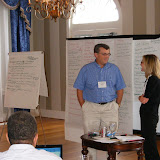
The VAM Governing Council met in Luray from Wednesday, July 7th - Friday, July 9th to discuss strategic planning, opportunities, and challenges for the organization over the next couple of years. We will soon be looking for feedback from our membership at large to help guide and inform our decision-making. Look for more on that soon!
Tuesday, July 6, 2010
Richmond Tourism Summit, July 28th
Registration is now open for the Richmond Tourism Summit, hosted by the Virginia Hospitality & Travel Association (VHTA). The Richmond Tourism Summit will take place on Wednesday, July 28, 2010 from 9:00 am to 12:00 noon at the Virginia Historical Society.
The Richmond Tourism Summit will provide an opportunity to highlight the economic contribution of tourism. Industry experts, policy makers and members of the tourism community will foster discussion on recent industry trends, forecasts and how federal and state policy affects all tourism large and small. Participants will hear from the American Hotel & Lodging Association; National Restaurant Association; Greater Richmond Convention & Visitors Bureau; Virginia Film Office; Carrie Cantrell, Assistant Secretary for Policy to the Secretary of Commerce & Trade; The Honorable Delores McQuinn (D-Richmond); and The Honorable Chris Peace (R-Mechanicsville).
The Richmond Tourism Summit is hosted by the Virginia Hospitality & Travel Association (VHTA) at no cost to participants. All are encouraged to attend and bring a colleague. Please make your reservation today by filling out and returning a registration form to Veronica Briggs by email, veronica@vhta.org, or fax, 804.285.3093.
Saturday, June 26, 2010
Great Marketing Opportunity for VAM Members!
We have partnered with Highway Information Media, LLC to bring you a great marketing opportunity, right when you need it most! We have heard wonderful feedback thus far on this program. Many of our members are wasting no time taking advantage. But act fast - we are only offering this great program through July 2010. Find out more.
Subscribe to:
Posts (Atom)