Thursday, August 29, 2013

Morven Park; Leesburg, VA
VAM recently traveled to Leesburg, Virginia on August 22, 2013 for the presentation of our popular summer conservation workshop and historic Morven Park was the perfect location. 


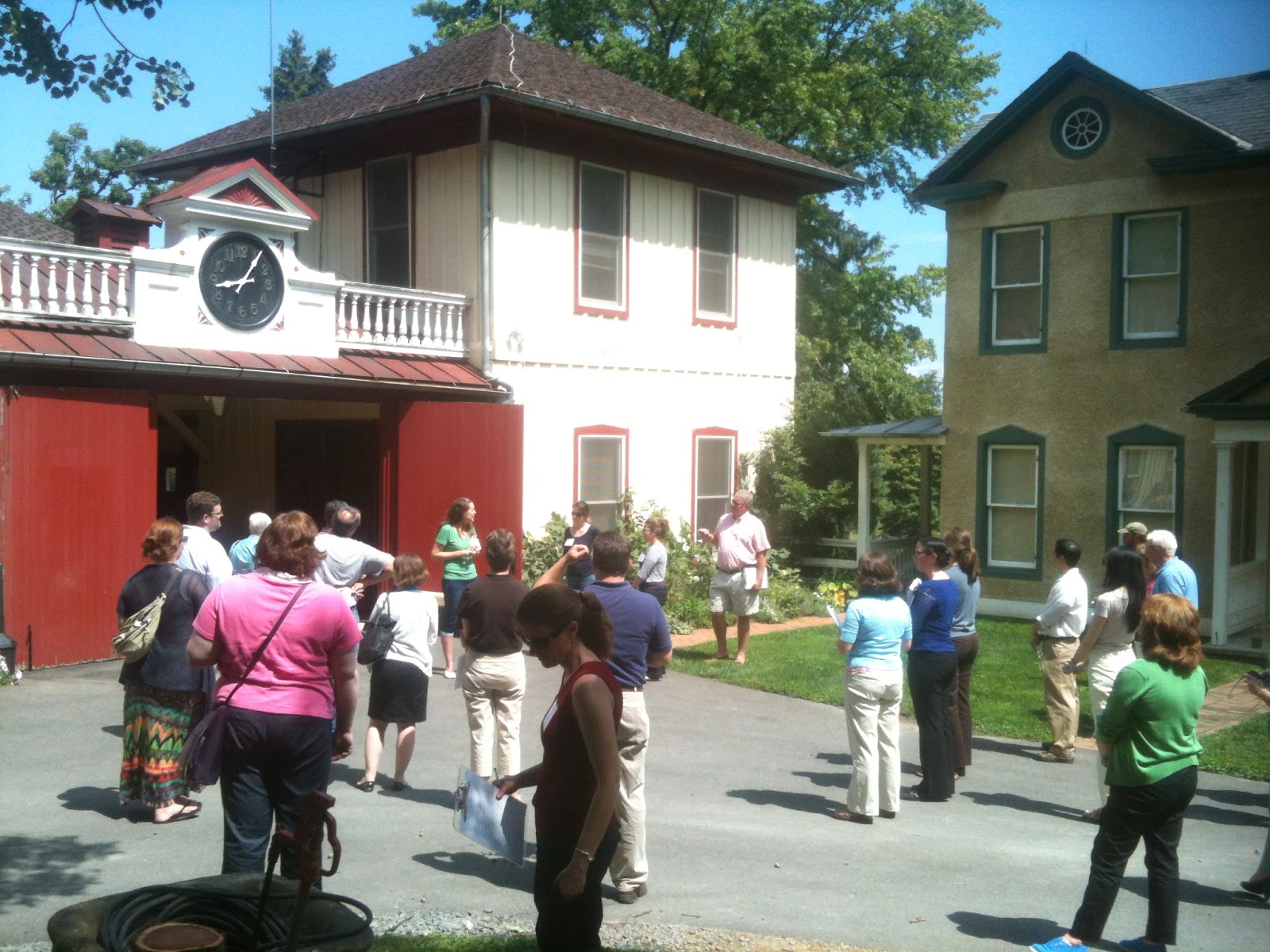
Expert speakers, Alyson Rhodes-Murphy (Henrico County and Jana Shafogoj (Morven Park), presented the day-long session 'Care of Historic Structures' to a full house of 35 attendees. Below are a few photos from our beautiful day in horse country. 

Our mascot 'Virgil' makes some big friends!


Workshop attendees were able to get hands-on training on how to assess historic structures on a tour of Morven Park's outside buildings. 


What a great day we had! Be sure to visit Morven Park and the many amazing historic and cultural sites in the Leesburg area. 

Are you looking to boost your skills? We've just released our Annual Workshop Series for 2013-2014 Season. Read more here!  

Sunday, August 25, 2013

Introducing VAM's New Assistant Director


It's an honor to be writing to you as VAM’s new Assistant Director. As a member of the Virginia Association of Museums, I've greatly appreciated and admired the fantastic conferences, informative programs, and excellent networking opportunities that I've experienced over the years, and I'm eager to have the opportunity to give back to the organization that has given so much to me throughout my career. My respect for VAM has only grown though after seeing first-hand the level of passion and dedication to the museum profession that exists amongst its staff, council, volunteers, and consultants.

It's been an honor to be part of this extended family over the past two years as project manager of the grant-funded Virginia Collections Initiative. I’m very proud to have had the opportunity to assist the incredibly diverse museum, library, and archive communities in Virginia and Washington, DC and of the work I’ve accomplished, from assisting members with renewals to expanding VAM’s recognition nationwide with the Top 10 Endangered Artifacts program. But I’m most grateful to now have the opportunity to take on a permanent leadership role at one of the most well respected museum associations in the country and continue to work alongside some of the best people I’ve ever met. Having worked with many of you already too, I look forward to building on our friendships and offer you my dedicated support in the years to come.

During the interview, I was asked what the greatest challenge would be, it was easy to reply, “filling Jennifer’s shoes”; but I feel confident in my abilities and 17 years of experience in the nonprofit cultural sector. As I’ve helped with the transformation of Downtown Richmond to an arts and cultural district, as founder of the popular First Fridays Art Walk, I look forward to sharing my passion with VAM to take it to its next stage too. The opportunities seem endless thanks to the many individuals, institutions, and businesses dedicated to our museum field.

Best,
Christina

Thursday, August 8, 2013

The Continuum of Excellence: Where Should Your Museum Begin?

VAM's upcoming member newsmagazine, the VAM Voice, will feature AAM's Continuum of ExcellenceThe new Continuum offers opportunities for various levels of assessment, feedback and recognition that build on one another. Programs along the Continuum include (but are not limited to) the following:

Pledge of Excellence
The Standards and Excellence Program (StEPs)
Museum Assessment Program (MAP)
Conservation Assessment Program (CAP)
Core Documents Verification
Accreditation (Association of Zoos and Aquariums (AZA) and Alliance)

It's easy, however, for museums - particularly those with small or all-volunteer staff, to know where to begin in this process. Thankfully, AAM has created a handy quiz, entitled The Continuum of Excellence: A Getting Started Guide, to help you navigate these opportunities and find the right one for your museum. Check out the quiz, and begin today on  your path to excellence!

Thursday, July 11, 2013

Jumping in with Both Feet: Reasons to Participate in Virginia's Top 10 Endangered Artifacts Program

As VAM is wrapping up its nomination period for the 2013 Virginia's Top 10 Endangered Artifacts Program, we thought we'd use this space for a little food for thought.

In it's third year, Virginia's Top 10 program has already come a long way. The program has been replicated already in several states, and two more states have plans to launch similar programs. Why? To put it simply, it's been a great success for the nominating museums and for VAM! Here are a few stats:


  • Back in 2011, we logged over 100,000 public votes for the inaugural "Top 10" !
  • Last year's program resulted in over 100 high-quality press clippings from media outlets such as The Washington Post and Virginia Living magazine, as well as radio (WTOP) and TV coverage!
  • Our second year resulted in over 120,000 public votes cast for conservation.
  • In this, our third year, we have already been picked up by the AP, and we haven't even announced our nominees yet!
  • To encourage donations to nominating museums, we have added a "donate" button to each nomination entry on this year's voting website. We hope that this results in museums attracting not only attention, but donations in support of conservation.
  • Many of our nominees from prior years have had great success leveraging their participation to get support for conservation efforts. From securing volunteers to funding, the Virginia's Top 10 Endangered Artifacts has been instrumental in many of our nominees and honorees conservation success stories!
Here's one final piece of good news - it's not too late to nominate! We'll be accepting nominations through this week and it only takes 10 minutes to nominate an artifact from your collecting institution! What are you waiting for?? Make a nomination now!

Tuesday, June 11, 2013

Historic House Museums: Branching Out

by Jody Allen

Historic houses offer visitors an authentic look into the past. Decorated and furnished with historical accuracy, historic houses tend to offer an immersion experience for their visitors. Unfortunately, attendance for historic houses has dwindled over the years and many establishments are looking for unique ways to boost visitation. Here are some innovative tactics that can help remedy low audience numbers.

Local Art
Many historic houses have available, unused rooms. Instead of leaving these rooms vacant, why not offer a place to showcase local artwork? Local art can help bring a different audience into your historic house – an audience that may not otherwise come, or who may not even be aware of your historic site! If the idea of including artwork unrelated to your site doesn’t interest you, consider asking local artists to create pieces inspired by your historic house. Not only would these pieces bring in a new audience, but they would also relate to your establishment. Another art related idea to consider is renting out available rooms to individual artists as studio space. 

Events
Historic houses make great locations to host small outdoor events. If you’re looking to bring in an audience, consider hosting a concert. Something simple that showcases local talent can attract a decent-sized crowd to your location. If money is an issue, charging a small entry-fee could help. Additionally, a “concert on the lawn” where attendees bring their own chairs and blankets alleviates the stress of providing seating. For example, Richmond’s Wilton House Museum is hosting a Jammin’ on the James Concert Series this summer.
In addition to concerts, feel free to explore other outdoor event possibilities. Consider hosting a farmers market, family day, or historic re-enactments.  Anything that can attract new audiences can prove beneficial to your historic house and keep it a relevant component of your community.

Community Partnerships
Interacting with your community is a great way to attract visitors and can lead to steady visitation. Historic houses tend to have plenty of outdoor space that can be used for community-based activities. Offering a community garden is just one way to incorporate members of the community. A community garden can help educate people on proper agriculture practices, as well as help build a stronger community. The strict definition of a community garden is one that is gardened collectively by a group of people. Partnering with a local garden club or a nearby community association can forge new ties in your community that will bear both figurative and literal “fruit.”


If your historic house has neighboring historic houses, you may want to also consider joint-hosting a community walk or other fitness event. These events promote healthy lifestyle choices while educating participants on the history of the area. For example, in Richmond, there is a 10K walk entitled "Go! Discover Richmond" that is run through the city's SportsBackers organization, but partners with sites throughout town. Another, simpler option is making sure you are on your town’s listing sites of interest. For example, visitors to Tappahanock may visit you if you are part of their town walking tour

Teachers: Stewards of Future Audiences
If you want to engage younger generations, even if you cannot accommodate large school groups, reach out to teachers in your community. Offer an open house for educators, distribute free passes to staff of your local elementary school, and consider hosting teacher workshops. VAM has a listing of some teacher workshops throughout the state, and many historic houses and small museums cultivate their school relationships directly through building relationships with the teachers. Additionally, reach out to scouting and other youth organizations and see what other community partnerships could develop as you think 'outside' the box and look at both your site's offerings and your community's needs.

Stay Tuned to VAM
We will be hosting a Summer Conservation Series Workshop on the Care of Historic Structures in August. Additionally, we'll be hosting a pre-conference activity on historic houses on Saturday, March 15, 2014 in Alexandria. We'll be announcing more information on that as the time gets closer. Stay tuned! Additionally, Preservation Virginia is planning an event for historic house staff on October 22nd, as a part of their annual conference. More details will be released about that soon as well!

Thursday, May 9, 2013

Salem Museum's "You-Seum" Exhibit, by John Long


Local history museums like us are always up against demographics. I often say you don’t appreciate local history until you’re old enough to remember some of it. As a result it’s sometimes hard to engage the younger generation and involve them in our mission.  This in part led us to our first foray into the “pop-up museum” phenomenon a few weeks back.

We called it the “You-Seum--a one-night exhibition designed by you!” We shaped it around the theme “Great-Grandma could have never imagined…” and invited the public to bring in an item to illustrate that theme. We set few ground rules, allowing the participants to drive the discussion in their own way. The turn-out, while smaller than we would have liked (there were several other events in town that lovely April night) but enthusiastic. The ages ranged from 6 to over 90. The six-year-old came to show off her Disney Princess collection.

The entries were insightful and thought-provoking. One of our members brought his tablet and e-reader; technology obviously outside of Great-Grandma’s imagination. Another brought a photo of herself having coffee with an African American friend--an encounter her great grandmother probably would have never sanctioned. The assistant director opined about the frenetic pace of modern life, which would have baffled our more relaxed ancestors. She illustrated it with a dvd showing of the Andy Griffith episode “Man in a Hurry.” One of our older members brought a slightly risqué sculpture--her great-grandmother could have never imagined such a thing in a respectable museum.

One participant grew up on a small Chesapeake Bay island, which was fundamentally transformed a generation ago when a bridge was built to the mainland. She brought in a nostalgic display of hometown items showing what was gained--and what was lost-- when the modern world intruded onto her island.
My own great-grandparents’ farm is now the site of a strip mall, mostly vacant, where the most popular shop is Dunkin’ Doughnuts. So I brought a dozen assorted pastries--Great-Grandma Long probably never tasted one, much less could foresee them sold from her cornfield. For the first time in my career I put out the sign “Please eat the exhibit.” Around the room, conversations mulled the changes we’ve all seen in such a short period of time. One of our goals was to get people thinking, and we did it.

On the whole, it was a most enjoyable evening and we plan to offer it again with a different theme. Along the way, if we can achieve a reputation as a museum that has more than static exhibitions to observe passively from behind velvet ropes; as an innovative facility where visitors can learn from enjoyable, engaging programs, then we’ll have crossed the bridge from yesterday’s museum to a brighter tomorrow.

Tuesday, April 9, 2013

Handling Public Relations Effectively: For Organizational Leaders, Boards, and Stakeholders


Today I had the privilege of attending a seminar entitled, “Avoiding the Public Relations Cliff: Lessons Learned from the UVA Board and President Crisis,” hosted by the Virginia Society of Association Executives. The speakers were Susan S. Gaston, president and owner, The Gaston Group and Joel Rubin, APR, founder and president, Rubin Communications Group. Both of these seasoned professionals in the area of public relations (PR) gave us a synopsis of “18 very bad days” in June of 2012 when UVA experienced an unexpected ‘coup’ of University President Teresa Sullivan.

The episode at UVA was presented as a case study and a springboard for discussion on managing crises, understanding the various audiences that follow your organization’s actions, working with and managing the media, and knowing who will be a spokesperson and when and how your organization should conduct interviews or make statements in times of crisis.

To provide just a few of the takeaways from this seminar, the speakers outlined the following steps to take if you find your organization in a PR crisis:

Be candid and acknowledge the crisis / problem
Offer an explanation (do not skirt this by “issuing statements,” you may need to answer some hard questions)
Contrition / verbalization – be honest, and if necessary, contrite about what has happened
Consultation – consider whether your organization would benefit from either legal or PR expert advice.
Commitment – demonstrate and verbalize your organization’s commitment to solving the problem or mitigating the crisis.
Restitution – this goes hand-in-hand with commitment. If an action needs un-doing, or steps need to be taken to remedy the situation, have a plan and execute it.

Another excellent facet of this seminar dealt with board responsibilities, board training, and the characteristics of excellent board leadership. Stay tuned – we’ll follow up with another post on that soon!